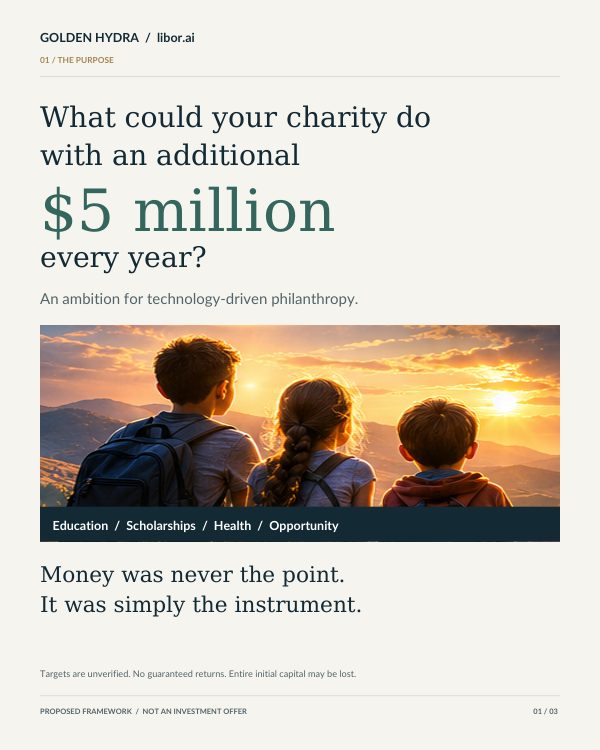
What could your charity do with an additional $5 millionevery year?
Pure love of mathematics, put to work to change lives. An ambition for technology-driven philanthropy: machine learning in the service of education, scholarships, health and opportunity.
Ambition A goal we are working toward, not a forecast or a promise. Targets are unverified and the capital can be lost.
100%of realized net profit goes to the donor and to the charities the donor chooses
0%kept by libor.ai: no management fee, no performance fee
Openmethods and results published, failed experiments included
Money was never the point. It was simply the instrument.
Why this exists
A fund that exists to give, not to keep.
We build mathematical models that look for patterns in financial markets. The question behind libor.ai is simple: what if the result of that work did not enrich a fund manager, but a scholarship, a clinic, a young person's first real chance?
Education
A door that opens
Scholarships that give a talented child a path their family could not pay for alone.
Health
Care that reaches
Prevention and treatment where a modest sum changes a great deal for a whole community.
Opportunity
A first step
Training, tools and a first job: the start that decides what comes after.
What an amount can be divided into (arithmetic, not a promise)
$50,000= 5 scholarships of $10,000
$500,000= 50 scholarships of $10,000
$5,000,000= 500 scholarships of $10,000
Unit sizes are chosen only to make the numbers concrete. What a charity actually funds, and what it costs, is for the charity to decide.
02 / The donor model
One donor. One commitment.
A defined allocation of realized net profits after 12 months, set out in a written agreement before anything starts.
$5,000
Initial donor-owned risk capitalHeld in the donor's own account at a regulated institution. Institution and custodian are still to be selected.
First$1,000,000100% to the donor
Every dollar above$1,000,000100% to donor-selected charities
Illustrative allocation
This only shows the arithmetic of the proposed agreement. It is not a forecast of any result.
$1,000,000Donor
$5,000,000Selected charities
120,000%Implied return on the $5,000
×1,200
A reality check, in plain numbers. Turning $5,000 into $6 million in 12 months is a 1,200-fold increase. Compounded over 260 trading days that is roughly 2.8% net growth on every single trading day, with no extended losing streak. That is an exceptional result and not what we expect as the normal case.
Most outcomes of any trading programme are smaller than the target, and many are losses. Charities receive nothing unless realized net profit exceeds $1,000,000.
Distribution under a written agreement, subject to legal and tax review.
Where every dollar goes
Nothing skimmed. Nothing hidden.
In the traditional fund model the manager is paid whether or not clients profit. We propose the opposite: the profit belongs to the donor and to the good the donor chooses.
100%of realized net profit to the donor and donor-selected charities
0%of profit kept by libor.ai
0%management fee charged to the donor
0%performance fee on profits
Proposed commitments, to be fixed in the written agreement before a donor commits anything.
Traditional fund modelThis proposal
Share of profit kept by the managerCommonly about 20% as a performance fee0% (proposed)
Fee in a year with no profitCommonly about 2% of assets, charged regardlessNone (proposed)
Who decides where the good goesNo one: profit goes to the manager and investorsThe donor, who selects the charities
ReportingVaries by firmAnnual independent audit (firm to be appointed) and open methods, failures included
“2 and 20” is the traditional hedge-fund fee model; actual fees vary by firm.
The costs that do exist, stated plainly
Trading costs (spread and commission) are part of every result we show; the negotiated broker rate is 1 USD round turn per 100,000 units.
Any fee charged by a third party, such as a custodian or the licensed manager, will be disclosed in writing before the donor commits.
How libor.ai itself is financed will be set out in the written agreement.
For whom
Four ways to take part in the conversation
The framework is still a proposal. These are the roles it is designed around, and what each would honestly mean.
Individuals
The donor
You provide $5,000 of your own risk capital and decide which charities would receive the allocation above $1,000,000. You bear the risk of losing the capital.
Charities
The beneficiary
You would be named by a donor, not paid by us. Nothing is received unless the agreed profit threshold is reached. You carry no financial risk and no obligations.
Foundations
The partner
You can help shape the governance: review the agreement, the audit set-up and the reporting that charities and donors would need.
Family offices
The reviewer
You can scrutinise the research and the structure with your own advisers, and, if it proves sound, introduce it to donors in your network.
03 / Technology & governance
Intelligence with accountability.
Advanced AI, high-performance computing and two decades of quantitative experience, held to a simple standard: a result only counts once it survives real trading costs.
Trading objectives: research targets, not verified performance
52%+Target win rate
>1:1Net reward / risk
50Trades per day
12,000Trades per year
30 secTo a few minutes per trade
WeeklyPortfolio recalibration
Proposed governance
Ownership
Donor-owned account at a regulated institution.Proposed. No institution has been selected.
Execution
A licensed manager, subject to regulatory approval, running Golden Hydra technology.To be appointed. None is engaged today.
Distribution
Written agreement; charities selected by the donor.
Assurance
Annual independent audit by a recognised audit firm.To be appointed. No audit firm has been engaged yet, and we will name one only once an engagement exists.
Transparency
Audit funding by libor.ai proposed; charitable use independently overseen.
Subject to independent legal, regulatory, tax, custody and audit review.
04 / Evidence
What we have actually measured
Charities and donors should see the uncomfortable parts too. These are preliminary research notes, not audited results.
~150 Mrecorded bid/ask ticks across 8 FX pairs used for validation
1 USDround-turn cost per 100,000 units at the negotiated broker rate; simulations assume 3 USD to leave room for slippage
20–50 piptypical spread on several cross pairs around the daily rollover
7 of 164candidate strategies still profitable on Training and Test once real spreads are applied; all EURUSD
Do backtests without spread overstate results?Yes, strongly. A 13-strategy portfolio that looked clearly profitable turned negative on real bid/ask fills.
Which pairs survive realistic costs?Only EURUSD so far (spread about 0.1 pip). Crosses and JPY pairs did not.
Can machine-learning filters lift results out of sample?Not reliably. Neural sizing and trade filters improved training numbers but not the validation period.
What did help out of sample?Dynamic strategy selection and a drawdown circuit breaker cut drawdown a lot while profit stayed similar.
Where the project honestly stands
DoneResearch data and tick archive
DoneReal-tick cost study on simulated trades (preliminary)
In progressNative replay of the trained neural models on tick data
PlannedLive paper-trading record, verified by a third party
PlannedIndependent review of the methodology. We will publish who reviewed it and what they found.
PlannedLegal, regulatory, tax and custody review of the donor structure
The validation window is only five weeks and contains one correlated shock. These notes are hypotheses to be confirmed on a longer, live record. No client money is managed today.
Read it for yourself
The documents
The framework and the research behind it, in full. Download them, share them, and take them to your own advisers.
Framework · English · 3 pages
Created to give more
The purpose, the donor model with its illustrative allocation, and the proposed governance. A proposal, not an offer.
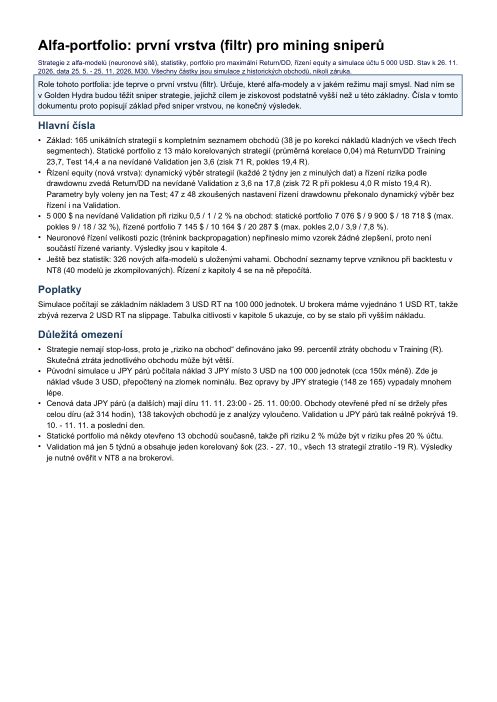
165 strategies with full trade lists, portfolio construction, equity control, a $5,000 account simulation and cost sensitivity.
Read with care. The figures come from bar-based simulations. Our later real-tick test, summarised in the Evidence section, shows that such simulations overstate results once real bid/ask spreads are applied.
Leave your address and tell us who you are. We will send occasional research notes and, when there is something concrete to review, an invitation to do it with us. No trading signals, no sales pitch.
We store only your email address and the role you choose. Nothing here is an offer, and no money is requested or accepted through this site.